Starting art can feel exciting, but it can also be a little confusing.
Walk into an art store or browse an art website, and you'll find hundreds of pencils, brushes, paints, papers, canvases, and other tools. As a beginner, you may wonder, "Do I really need all of this?"
The simple answer is no.
You don't need an expensive collection of art supplies to start creating. A few basic materials are enough to learn, practice, and discover what kind of art you enjoy.
In this guide, we'll look at the essential art supplies for beginners and explain what each one is used for.
If you're completely new to art, you may also want to start with our Introduction to Art: A Guide for Beginners. You can then explore Different Types of Art and learn about the Elements of Art before choosing your materials.
Do you really need expensive art supplies?
One of the biggest mistakes beginners make is thinking that better materials automatically create better artwork. They don't.
Good-quality materials can certainly make the process more enjoyable, but your skills, practice, observation, and creativity matter much more.
You can create beautiful drawings with a simple pencil and a piece of paper.
Start with what you have. As you learn more about your preferred medium, you can slowly invest in better supplies.
A simple collection of good basic materials is much more useful than a large box of supplies you rarely use.
1. Sketchbook or drawing paper
Sketchbook is one of the most useful things an artist can have. It gives you a place to practice, experiment, make mistakes, and record your ideas.
You don't have to make every page beautiful. In fact, some of the best sketches are quick and unfinished.
What to look for?
For basic pencil drawing, choose paper that is:
- Smooth enough for comfortable drawing
- Thick enough to handle erasing
- Not too expensive
- Easy to carry
If you plan to use watercolor, choose watercolor paper instead. It is thicker and designed to handle water without becoming badly damaged.
Beginner tip
Don't wait for a "perfect idea" before using your sketchbook.
Draw something every day—even if it is just a cup, a leaf, your hand, or something sitting on your desk.
2. Graphite pencils
A good set of graphite pencils is enough to begin learning drawing.
Pencils are usually marked with letters and numbers such as H, HB, B, 2B, 4B, and 6B.
The letters tell you about the hardness of the pencil.
- H pencils are harder and create lighter marks.
- HB is a good middle option for everyday drawing.
- B pencils are softer and create darker marks.
- Higher B numbers, such as 4B or 6B, are useful for deeper shadows.
You don't need every pencil available.
For a beginner, a small set such as HB, 2B, 4B, and 6B is a good starting point.
What can you do with pencils?
You can use them for:
- Sketching
- Shading
- Portraits
- Landscapes
- Still-life drawings
- Practicing light and shadow
Beginner tip
Don't press too hard when drawing.
Start with light marks and gradually build darker areas. This gives you much more control over your drawing.
3. Eraser
An eraser is not just for correcting mistakes. Artists also use erasers as a drawing tool. A good eraser can remove unwanted lines, create highlights, and help shape shadows.
Two useful types
Plastic or vinyl eraser
This is the common white eraser. It works well for removing graphite cleanly.
Kneaded eraser
This soft eraser can be shaped with your fingers. Artists often use it to gently lift graphite and create highlights.
For example, when drawing a face, you can use a kneaded eraser to bring out highlights on the forehead, nose, or cheeks.
Beginner tip
Don't be afraid of making mistakes.
Erasing and correcting your drawing is a normal part of learning.
4. Pencil sharpener
A sharp pencil gives you better control and allows you to create both fine details and clean lines. Choose a sharpener that gives your pencils a smooth, pointed tip without breaking the graphite repeatedly.
A simple manual sharpener is enough when you're starting.
Beginner tip
Keep your pencil sharp, but don't sharpen it unnecessarily.
A slightly rounded pencil tip can also be useful for soft shading.
5. Ruler
A ruler may seem simple, but it can be very useful. It helps you draw:
- Straight lines
- Buildings
- Objects
- Grids
- Basic perspective guides
- Geometric shapes
You don't need a special artist ruler. A basic ruler is perfectly fine for beginners.
As you learn perspective and composition, you'll find yourself using it more often.
Beginner tip
Don't rely on the ruler for everything
Practice drawing straight lines by hand too. Developing your hand control is an important part of learning to draw.
6. Colored pencils
If you enjoy adding color to your drawings, colored pencils are an easy medium to start with. They are clean, portable, and don't require water or complicated preparation. You can use them for:
- Flowers
- Animals
- Landscapes
- Illustrations
- Portraits
- Simple decorative artwork
Start with a basic set rather than buying a huge collection. As you become more comfortable, you can learn about layering, blending, shading, and color mixing.
Beginner tip
Don't press hard immediately. Build color slowly by adding several light layers. This usually gives you more control and smoother results.
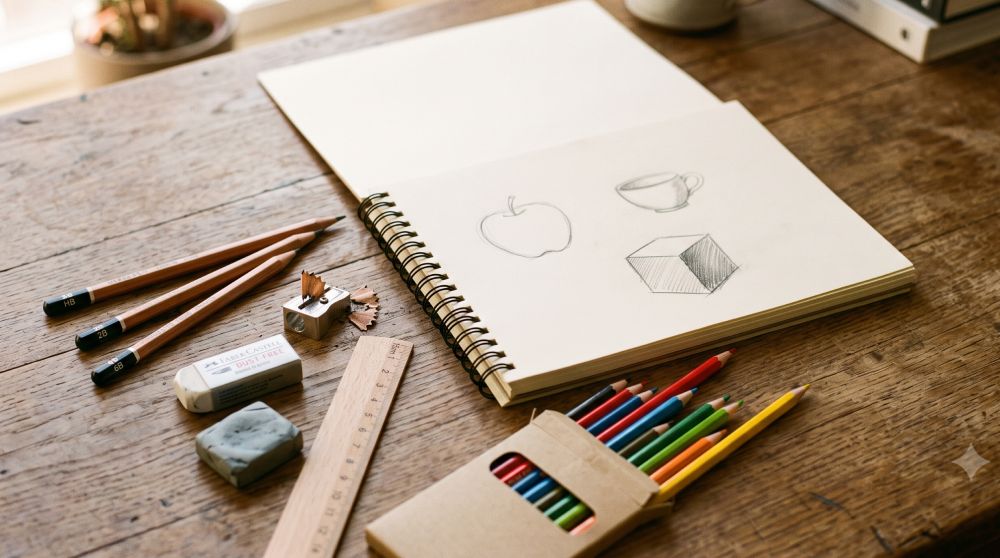
A simple beginner's drawing kit
If you are completely new to drawing, you don't need to buy everything mentioned above. A basic starter kit can be as simple as:
- One sketchbook
- HB pencil
- 2B pencil
- 4B pencil
- 6B pencil
- White eraser
- Kneaded eraser
- Pencil sharpener
- Ruler
- Small set of colored pencils
That's enough to spend many hours learning and practicing.
Now let's look at the supplies you may need when you want to explore painting and other art mediums.
Remember, you don't need to buy everything at once. Choose materials based on the type of art you want to try.
7. Paint brushes
Paint brushes come in different shapes and sizes, and each one creates a different type of mark.
For beginners, a small collection of brushes is enough. You can start with:
- Round brush – useful for details, lines, and small areas
- Flat brush – useful for larger areas and straight edges
- Filbert brush – useful for soft edges and blending
- Small detail brush – useful for fine details
You don't need dozens of brushes when you're starting.
Beginner tip
Try different brush sizes while painting. You will quickly learn which brushes feel comfortable for your style.
Also, clean your brushes properly after every painting session. Dried paint can damage the bristles.
8. Acrylic paints
Acrylic paint is a popular choice for beginners because it is easy to use and dries relatively quickly.
It can be used on different surfaces, including canvas, paper, wood, and some other prepared surfaces. A basic acrylic color set can include:
- Titanium white
- Black
- Primary yellow
- Red
- Blue
- Green
- Burnt sienna or another earthy brown
You can mix many different colors from a small number of basic paints.
Beginner tip
Don't buy a large number of colors immediately.
Learning how to mix colors can actually help you understand color better and give you more control over your paintings.
If you want to learn more about how artists use color, you can also revisit our guide to the Elements of Art.
9. Watercolors
Watercolor is another wonderful medium to explore. Unlike acrylics, watercolor is usually painted on special watercolor paper and uses water to create transparent layers.
A basic watercolor setup can include:
- Watercolor paints
- Watercolor paper
- A few brushes
- Water container
- Palette or mixing surface
- Paper towel or cloth
Watercolors are especially enjoyable for landscapes, flowers, skies, loose paintings, and quick studies.
Beginner tip
Use watercolor paper instead of ordinary printer paper. Regular paper can become wrinkled or damaged when it gets wet.
10. Canvas
If you want to try acrylic or oil painting, you'll eventually need a suitable painting surface. Canvas is one of the most common choices.
You can find canvas in many sizes, from small canvases for practice to large canvases for detailed paintings.
For beginners, a small or medium-sized canvas is easier to handle.
Types of canvas
- Stretched canvas
- Canvas panels
- Canvas sheets
- Canvas boards
A stretched canvas is already fixed over a wooden frame, while canvas panels and boards are usually thinner and easier to store.
Beginner tip
Don't start with a very large canvas unless you already know what you want to paint.
A smaller canvas lets you practice without using too much paint or spending too much money.
11. Palette
A palette is used for holding and mixing your paints. You can buy a traditional wooden palette, a plastic palette, or even use a simple disposable palette.
For acrylic painting, a palette with a smooth, non-porous surface is convenient because it is easier to clean.
You don't need an expensive palette. Even a simple mixing surface can work when you're starting.
Beginner tip
Avoid putting too much paint on your palette. Start with small amounts and add more when needed. This helps reduce paint waste.
12. Water container
If you're using water-based paints such as acrylics or watercolors, you'll need water for cleaning and working with your brushes.
A simple jar or reusable container is enough. Many artists keep two water containers:
- One for the first brush rinse
- One for cleaner water
This can help keep your paint colors cleaner.
Beginner tip
Change dirty water regularly, especially when you're working with light colors.
13. Palette knife
A palette knife isn't essential for everyone, but it can be very useful when working with acrylic or oil paints. You can use it to:
- Mix colors
- Spread paint
- Create texture
- Make sharp edges
- Apply thick layers of paint
Palette knives can create effects that are difficult to achieve with a brush.
If you enjoy textured or expressive paintings, it can be a useful addition to your art kit.
14. Other useful art supplies
Once you start creating more artwork, you'll find a few other things useful. These aren't essential on your first day, but they can make your work easier.
Some useful extras include:
- Paper towels or an old cloth
- Masking tape
- Apron or old clothes
- Small spray bottle
- Mixing cups
- Pencil case or storage box
- Drawing board
- Clips
- Easel
You don't need to buy all of these.
Add them gradually when you find that you actually need them.
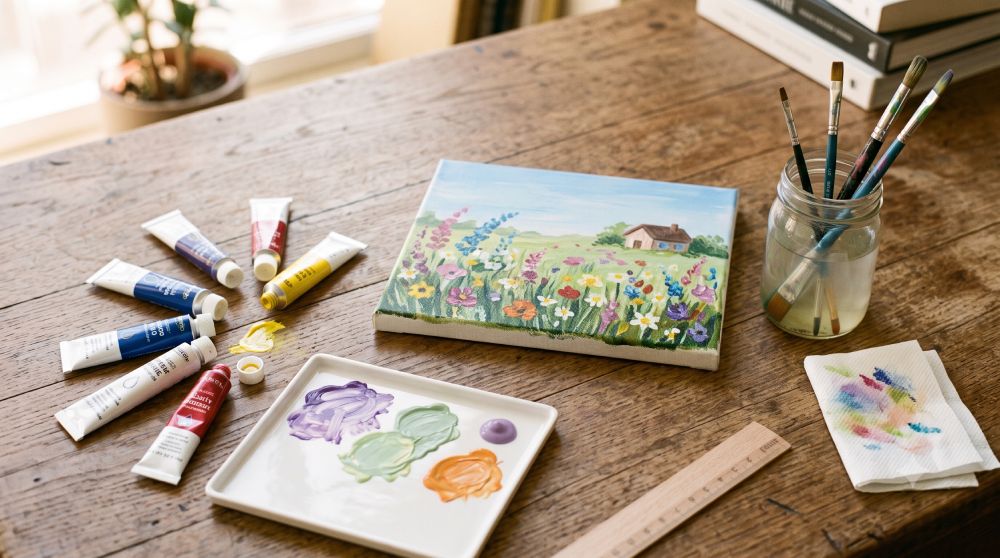
A basic painting starter kit
If you want to try painting without spending too much, you can start with:
- Small set of acrylic paints or watercolors
- 3–5 paint brushes
- Small canvas or suitable watercolor paper
- Simple palette
- Water container
- Paper towel or old cloth
- Pencil and eraser for basic sketches
This is enough to start experimenting with color and painting techniques.
If you're interested in different mediums, our guide to Different Types of Art can also help you decide which direction you want to explore.
How to choose art supplies as a beginner
With so many products available, choosing art supplies can become confusing. Here are a few simple things to keep in mind.
Start with the medium you want to learn
Don't buy oil paints, acrylics, watercolors, colored pencils, and every other medium at the same time.
Choose one and spend some time learning it.
Buy a small set first
A smaller set allows you to understand what you actually use before spending more money.
Choose reasonable quality
The cheapest materials aren't always the best choice, but you also don't need professional-grade supplies when you're learning.
Look for student or beginner-grade materials from a reliable brand.
Think about your space
If you work in a small room, consider materials that are easy to store and clean.
For example, watercolor and colored pencils are convenient if you don't have a dedicated art space.
Common mistakes beginners make when buying art supplies
Buying too much
It's easy to get excited and buy a huge collection of supplies.
But many of them may remain unused.
Start small and add things as you learn.
Choosing supplies only because they look professional
A beautiful wooden box full of expensive art materials won't improve your skills by itself.
Spend more time practicing than shopping.
Buying every color
You can mix many colors yourself.
Learning color mixing is an important part of becoming a better artist.
Ignoring the paper or canvas
Good paint won't always give good results if the surface isn't suitable for it.
Choose paper according to the medium you're using.
Not taking care of your brushes
Leaving paint to dry inside a brush can permanently damage it.
Clean your brushes after every painting session.
Frequently asked questions
What art supplies should a beginner buy first?
Start with a sketchbook, a few graphite pencils, an eraser, a sharpener, and a ruler. If you want to paint, add a small set of paints, a few brushes, a palette, and a suitable painting surface.
Is expensive art equipment necessary for beginners?
No. Good materials can make the process easier, but expensive supplies aren't necessary to learn the basics. Focus on practicing regularly and improving your skills.
Should I start with acrylic or watercolor?
Both are good options. Acrylics are useful if you want to paint on canvas and build up solid layers of color. Watercolors are a good choice if you enjoy transparent colors and painting on paper.
How many paint brushes do I need?
You can start with just three to five brushes in different sizes and shapes. You can add more later when you understand which brushes you use most.
What type of canvas should a beginner use?
A small or medium-sized stretched canvas or canvas panel is a practical choice for beginners. It gives you enough space to practice without making the project difficult to manage.
Do I need an easel?
No. An easel is useful, especially for larger paintings, but you can start by working on a table or another stable surface.
Your art supply checklist
Here's a simple checklist you can save for later.
| Supply | Beginner priority |
|---|---|
| Sketchbook | Essential |
| Graphite pencils | Essential |
| Eraser | Essential |
| Sharpener | Essential |
| Ruler | Useful |
| Colored pencils | Optional |
| Paint brushes | Essential for painting |
| Acrylic paints | If using acrylics |
| Watercolors | If using watercolors |
| Canvas | For canvas painting |
| Palette | For painting |
| Water container | For water-based paints |
| Palette knife | Optional |
| Easel | Optional |
| Apron/old cloth | Useful |
The most important thing is to start creating. You can always add more supplies later.
Why the right art supplies matter
Art supplies are tools. They help you bring your ideas to life, but they don't define your creativity.
A simple pencil can teach you about line, shape, form, texture, space, and value. A few basic colors can teach you how colors work together. A brush can help you understand different marks and textures.
The more you practice, the more you'll understand which materials suit your way of working.
Your goal shouldn't be to build the biggest art collection.
Your goal should be to create more art.
Conclusion
You don't need a huge collection of expensive art supplies to begin your artistic journey.
Start with a few basic materials, learn how they work, and practice regularly. As you discover the type of art you enjoy, you can slowly build your collection around it.
Whether you want to draw with pencils, experiment with colored pencils, paint with acrylics, explore watercolors, or eventually work on canvas, there is no single correct way to start.
Choose a medium, pick up your tools, and start creating.
Continue learning about art
If you're following this beginner art series, you can continue with: